
05 March 2024
How to Develop People-Centric Managers
Being a people-centric manager is not about endless praise and niceness. It is a robust approach to management that cultivates healthy, engaged employees who perform at their best.
With nearly 80% of employees feeling disengaged (Gallup, 2023), human-centric management is a sought-after approach. But despite employees actively craving this style of leadership, only a minority (29%) say their manager exhibits these skills (Gartner, 2022).
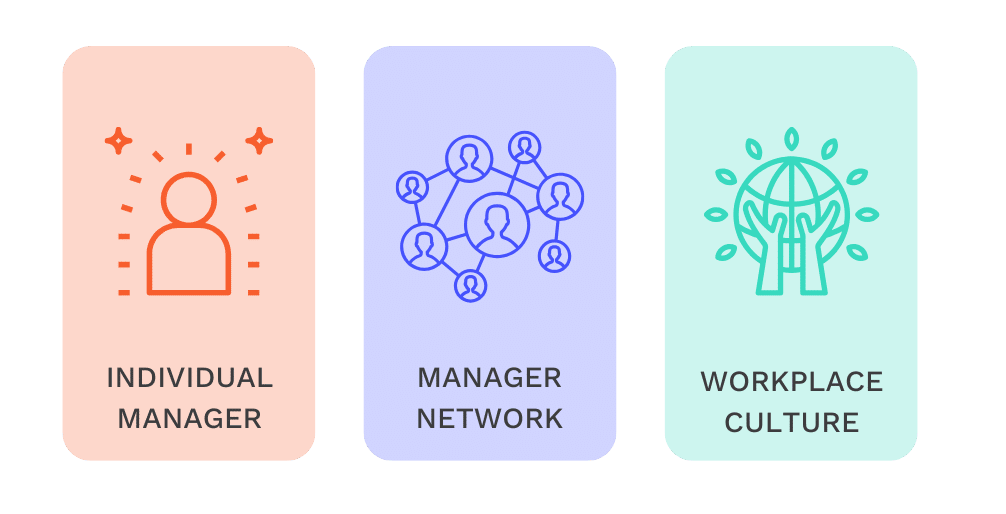
Implementing a people-centric manager development approach is one thing. The larger challenge is ensuring it endures. That’s why our team of business psychologists have developed a framework for sustainable people-centric manager development. It encourages a holistic approach and focuses on three core pillars: the individual manager, the manager network, and the workplace culture.
The Three Pillars of Sustainable Manager Development
Pillar 1: The Individual Manager
Organisations need to create opportunities for managers to advance their people-centric management skills. These opportunities should focus on interventions that build on both the awareness and skills of managers.
Awareness-based interventions:
- Psychometric assessments –Psychometric assessments help managers gain a deeper awareness of their strengths and development areas relevant to their management style.
- 360-degree feedback surveys – This approach offers comprehensive feedback from peers, direct reports, and superiors. As well as deepening self-awareness, the results provide targeted areas for development, guiding their growth.
- Performance reviews – Effective performance management includes goal setting, ongoing feedback, and coaching style discussions. Incorporating these elements enables managers to feel clear and in control of their development.
Skill-based interventions:
- Blended training solutions – This approach combines learning methods such as workshops, project-based learning, and micro-learning modules. A diverse learning approach is recommended to engage managers and maximise knowledge retention and application.
- Coaching/Mentoring – Integrating coaching and mentoring is powerful for growth. Managers receive personalised guidance and support and are held accountable for implementing changes.
Pillar 2: The Manager Network
For learning to take root, it needs to be supported by a collective commitment to change. That’s why establishing a strong peer-to-peer manager network is crucial. This could take shape through the following:
- Manager forums: These provide a platform for managers to share experiences, best practices, and challenges.
- Communities of Practice (CoPs): CoPs bring together communities of managers with similar interests or expertise. Together, they can discuss trends, share knowledge, and support one another. In fact, 79% agree they’ve learned new skills through their CoP (UCL, 2021).
- Cross-functional working: This enables managers to collaborate with colleagues from different departments. Doing so promotes collaborative problem-solving, diverse perspectives and experiential learning.
Building a vibrant, connected network for managers is crucial. It promotes social learning and helps people-centric management become more rooted in the organisation.
Pillar 3: The Workplace Culture
A sustainable manager development framework relies on the organisational culture to support it. Otherwise, efforts to introduce people-centric management may be short-lived. That’s why organisations need to consider the following three aspects of their culture:
1. Leadership
Leaders set the tone for managers to follow. That’s why their behaviour and impact need to be considered. When senior leaders demonstrate people-centric leadership behaviours, they set a positive example for managers to emulate. This fosters a culture where people feel valued, respected, and motivated to perform at their best.
2. Succession Planning
An effective approach to succession planning means proactively equipping people with people-centric skills. This should feature throughout the talent pipeline rather than waiting until someone enters management. This ensures the continuous development of a talent pipeline filled with capable, people-centric individuals.
3. The Corporate Strategy
People-centric management principles need to be embedded into the organisation’s overall strategy and values. This signals that the culture values and prioritises these skills. It also reinforces people-centric management as a key driver of its success.
By focusing on these 3 pillars, organisations will set the foundations for a people-centric management culture that is built to last.
Conclusion
Incorporating people-centric management development is a priority for many organisations. But to make it a successful investment, it must be sustainable. This means incorporating a holistic, whole-organisation approach that considers both the individual manager and their environment. Doing so ensures a real commitment to developing managers who cultivate long-term healthy performance.
Share



Share