
19 March 2026
The 5 Pillars of Team Resilience
Under pressure, even the most talented teams can struggle. The difference between those that perform and those that don't often comes down to five key factors.
The 5 Pillars of Team Resilience
Consider a team that, on paper, has everything it needs. Experienced people, clear roles, adequate resource. Yet when the pressure rises — a restructure, an ambitious deadline, a period of sustained uncertainty — the team struggles. Mistakes creep in. Communication breaks down. People start protecting their own patch rather than pulling together. The team doesn’t fail dramatically; it just quietly underperforms when it matters most.
This pattern is more common than most organisations realise. And it rarely comes down to individual capability. What’s missing is team resilience — the collective capacity to absorb pressure, adapt, and maintain performance through difficulty.
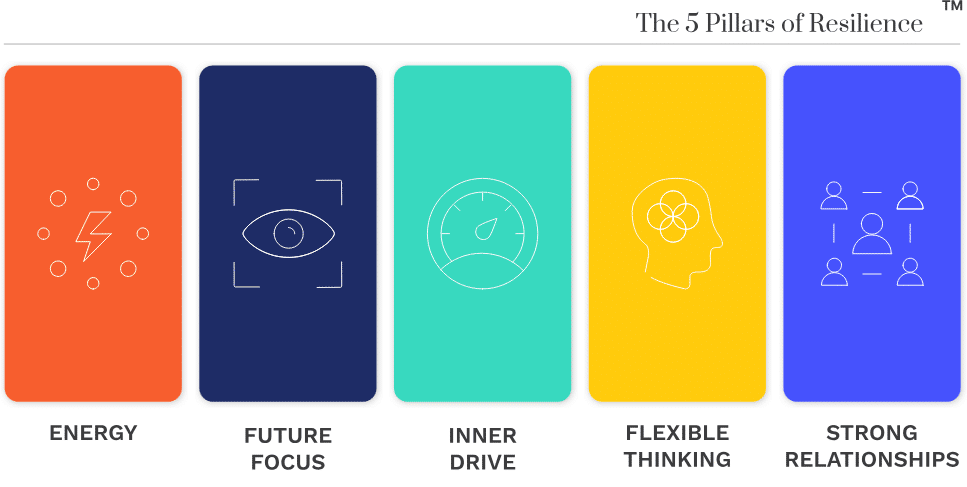
At The Wellbeing Project, we’ve developed an evidence-based framework for understanding and building exactly that. The 5 Pillars of Resilience gives organisations a clear, measurable model for what resilient teams look like in practice — and where the gaps tend to appear.
________________________________________
Pillar 1: Energy
At team level, Energy is about sustainable pace. It’s not just whether individuals are managing their own workload – it’s whether the team, as a unit, is operating in a way that’s sustainable over time.
Resilient teams have an explicit understanding of capacity. They push hard when it counts, but they also protect recovery time and flag early when demand is outstripping resource. In practice, this might look like a team that openly discusses workload in sprint planning rather than everyone quietly absorbing the overload.
________________________________________
Pillar 2: Future Focus
Future Focus is about shared direction. Resilient teams don’t just know what they’re working on — they understand why it matters and where it’s heading. That sense of collective purpose sustains the team during periods of change or uncertainty.
In practice, a team with strong Future Focus can articulate how their work connects to the wider organisational goal. When priorities shift – as they inevitably do – they recalibrate rather than unravel, because the destination is clear even if the route has changed.
________________________________________
Pillar 3: Inner Drive
Inner Drive, at team level, is about collective motivation and belief. It’s the team’s shared confidence in its own ability to succeed – the sense that what they’re doing is worth doing, and that they’re capable of doing it well.
This isn’t about manufactured positivity. It’s about teams that hold onto their belief in themselves when things go wrong, that learn from setbacks rather than being defined by them, and that maintain momentum even when external recognition is lacking.
________________________________________
Pillar 4: Flexible Thinking
Flexible Thinking is how a team responds to change and solves problems together. Resilient teams don’t default to “the way we’ve always done it.” They draw on the range of perspectives within the team, challenge their own assumptions, and generate options rather than locking onto the first solution that presents itself.
This pillar is particularly critical in organisations navigating ongoing transformation. A team that can’t think flexibly can block successful change – defaulting to rigid processes even when the situation calls for something different.
________________________________________
Pillar 5: Strong Relationships
Strong Relationships is the social infrastructure of a resilient team – the psychological safety, trust, and support that allow people to do their best work together.
In a team with strong relationships, people speak up when something isn’t working. They ask for help without it feeling like an admission of failure. They challenge each other’s thinking without it becoming personal. And when someone is struggling, the team notices and responds.
This pillar often gets treated as a “nice to have” – the team away day, the social events. But the research is clear: teams with high levels of psychological safety consistently outperform those without it.
________________________________________
How the pillars work together
The 5 Pillars don’t operate in isolation. A team without Future Focus will burn through its Energy faster, because sustained effort is harder to maintain when the destination isn’t clear. A team without Strong Relationships won’t make full use of its Flexible Thinking, because people won’t surface the ideas and concerns that lead to better solutions. Inner Drive suffers when Energy is chronically depleted.
This interdependence is why piecemeal interventions rarely move the dial. Building resilient teams requires a framework that addresses all five pillars together, diagnoses where the gaps are, and builds capability in a structured, measurable way.
________________________________________
Build your team’s resilience
If you’re looking to strengthen resilience across your teams, our Team Resilience Programme gives organisations a structured, evidence-based approach to developing all 5 Pillars — from diagnostic insight through to practical skill-building.
Find out more about the Team Resilience Programme.

Author Bio: Sandra Ordel is a Senior Business Psychologist at The Wellbeing Project, specialising in workforce resilience and neuropsychology. She works with organisations worldwide to measure and strengthen resilience, helping leaders build high-performing teams and cultures of healthy performance.
If you’re looking to strengthen resilience across your teams, our Team Resilience Programme is a structured, evidence-based approach to developing all 5 Pillars.
Share



If you’re looking to strengthen resilience across your teams, our Team Resilience Programme is a structured, evidence-based approach to developing all 5 Pillars.
Share